
I am trying to set levels for individual frequencies on the music program. However, if I select eg 250 Hz and click the up or down arrows, this moves the other frequencies. This may be because I am in standard mode but I can't find any way to switch modes.

You are using an out of date browser. It may not display this or other websites correctly.
You should upgrade or use an alternative browser.
You should upgrade or use an alternative browser.
Adjusting gain levels in Target 10
- Thread starter Teewens
- Start date

pvc
Well-Known Member
- Joined
- Apr 12, 2023
- Messages
- 3,583
- Reaction score
- 870
Maybe because sound waves are waves (and therefore related to each other), and not individual steps.if I select eg 250 Hz and click the up or down arrows, this moves the other frequencies.
If you only amplify the sound of "Do" when listening to the song → "Do-Re-Mi" then the song will sound different.
Or, maybe another way to look at it (as steps). There are actually 250 steps between 250 Hz and 500 Hz when observing in increments of 1 Hz.
Maybe read a DIY School Hearing Aids (v2.2) PDF File named (How Hearing Aid Gain Fits Your Loss).
pvc
Well-Known Member
- Joined
- Apr 12, 2023
- Messages
- 3,583
- Reaction score
- 870
Clip from DIY School Hearing Aids (v2.2) PDF File (02 How to Program your Hearing Aids);
Programming hearing aids for music:
Some hearing aids have factory “programs” that can be selected when listening to music. If you are interested in learning more about the details of a typical music program, then here’s a link to a PDF file named Starting out with a music program. It recommends changes such as disabling noise management, wind-noise management, and many more changes to prevent your hearing aids from altering the soundscape for the primary purpose of prioritizing speech.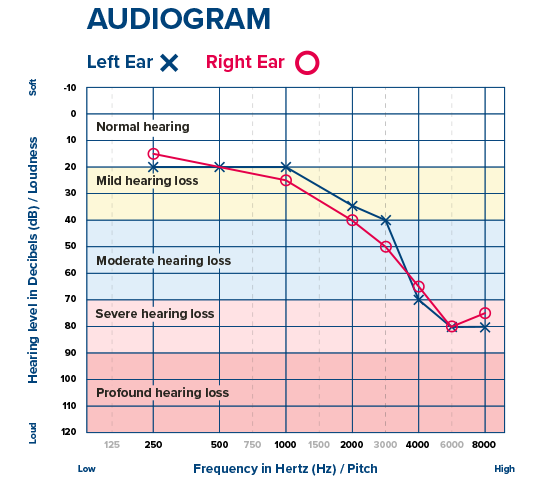
pvc
Well-Known Member
- Joined
- Apr 12, 2023
- Messages
- 3,583
- Reaction score
- 870
Oh, okay. Since hearing aids use Wide Dynamic Range Compression (WDRC) to compress and move incoming sounds to a higher range, that leaves some people with (with severe/profound hearing losses) not much room left to receive the compressed range. I think your hearing loss has enough room left. Caveat: This is only my non-professional understanding.

On my music program, the gain for G65 as set up by my audiologist was
I find this makes vocals overpower the bass, guitars etc on pop / rock and country. The vocals are harsh and somewhat distorted especially when multiple voices are heard. So I asked Chatgpt to suggest how to make music sound more natural and less distorted. It suggested that I changed gain to
This was based on my audiogram which I uploaded to Chatgpt. At first, I struggled to enter the values but I now understand how it works. I am going to try these values today as well as look at other suggestions in the document and from Chatgpt. On Tuesday I will discuss all of these changes with my audiologist .
| Frequency | Suggested Gain (dB) | Notes |
|---|---|---|
| 250 Hz | +5 | |
| 500 Hz | +20 | |
| 750 Hz | +32 | |
| 1000 Hz | +39 | |
| 1500 Hz | +40 | |
| 2000 Hz | +32 | |
| 3000 Hz | +25 | |
| 4000 Hz | +19 | |
| 6000 Hz | +17 | |
| 8000 Hz | +17 |
I find this makes vocals overpower the bass, guitars etc on pop / rock and country. The vocals are harsh and somewhat distorted especially when multiple voices are heard. So I asked Chatgpt to suggest how to make music sound more natural and less distorted. It suggested that I changed gain to
| Frequency | Suggested Gain (dB) | Notes |
|---|---|---|
| 250 Hz | +10 to +15 | Adds warmth & body to music (bass, drums) |
| 500 Hz | +15 | Support vocals & rhythm |
| 750 Hz | +20 | Helps vocal richness |
| 1000 Hz | +25 | Critical for vocal clarity |
| 1500 Hz | +28 | Smooth transition into upper mids |
| 2000 Hz | +25 | Reduce slightly if music sounds sharp |
| 3000 Hz | +20 | Moderate—too much sounds harsh |
| 4000 Hz | +15 | Controls brightness, watch for distortion |
| 6000 Hz | +10 | Keep modest due to your high-frequency loss |
| 8000 Hz | +8 (or less) | Go easy—avoid harshness or feedback |
pvc
Well-Known Member
- Joined
- Apr 12, 2023
- Messages
- 3,583
- Reaction score
- 870
I like to stick with Audiology Best Practice which is;
Yes, I understand that musicians may wish to strive towards achieving settings which are best for music. Though, I don't understand if, or how the desired results can be achieved. So I tend to bow-out of discussions about music. Sorry.
An Internet search may help find similar discussions.
- using Pure Tone Audiometry (PTA) to measure your hearing loss
- and REM/Real Ear Measurement to verify that the Calculated/Rx/Prescribed Gain (for that loss) is reaching your eardrums
Yes, I understand that musicians may wish to strive towards achieving settings which are best for music. Though, I don't understand if, or how the desired results can be achieved. So I tend to bow-out of discussions about music. Sorry.
An Internet search may help find similar discussions.
Last edited: